Sleep, textiles, and everyday design
How Gingerlily Pillowcases Shape the Sleep Surface
A pillow has two jobs that are easy to confuse. Its filling supports the head; its cover is what the face, hair, and hands actually meet. Gingerlily’s silk pillowcases belong to that second, quieter category, where fabric weight, seams, closures, and care determine how a bed feels in the small hours.
In the dim logic of bedtime, “pillow” can mean almost anything: the firm object tucked beneath the neck, the soft envelope around it, or the whole arrangement that gets pushed aside and reclaimed before morning. The distinctions matter. A pillow’s filling and shape influence its loft and support. A pillowcase changes the surface—its temperature, texture, and movement against skin and hair. One is a matter of structure; the other, of contact.
That difference is particularly useful to remember when considering a silk pillow. The phrase may refer to a cushion filled with silk fibers, or to a pillow covered in silk. These are not interchangeable designs, and neither automatically determines how well a pillow will suit a particular sleeper. A silk pillowcase can make the surface feel smooth and lightly cool, but it does not change the support provided by the pillow inside. Conversely, a silk-filled pillow may have a different feel and loft while still wearing a cotton cover.
Gingerlily’s pillowcases offer a practical study in the first idea: the cover as its own carefully designed layer. The collection includes Oxford and Housewife styles, along with different edge finishes, colors, and weights. Those details can sound decorative. They are decorative, in part. They are also the small engineering decisions that determine whether a pillowcase sits neatly, shifts easily, feels substantial, or asks for a little more attention in the laundry.
The case is not the pillow
A pillow’s principal task is to help support the head and neck in a comfortable position. That task depends on its fill, construction, and loft, as well as the sleeper’s preferred position and body. A cover cannot correct a pillow that feels too high or too flat. Nor does a luxurious surface guarantee that the pillow beneath it will provide adequate support.
A pillowcase, by contrast, is the textile interface. It lies between the pillow and the sleeper, and its qualities can influence the first impression of the bed: smooth or crisp, warm or cool to the touch, plain or bordered. Silk’s characteristic smoothness is often associated with reduced friction compared with rougher surfaces. Some people enjoy that sensation against the face or find it gentler on hair. These are matters of comfort and personal experience, not promises that a pillowcase will prevent wrinkles, treat skin conditions, or repair damaged hair.
Material matters, but so does construction. A silk pillowcase needs enough room for the pillow, a closure that keeps the insert contained, and seams or borders that make sense for the way it will be used. A small difference in profile—a border, a piped edge, a knife edge—can change the visual impression without changing the basic function. Meanwhile, the closure determines what happens when the pillow is turned, fluffed, or pulled into place.
Oxford and Housewife: two familiar silhouettes
The terms Oxford and Housewife describe common pillowcase styles rather than different kinds of silk. The distinction is easiest to see at the edge. An Oxford pillowcase has a fabric border around the central panel. Gingerlily’s Ebury Oxford Silk Pillowcase, for example, has a seven-centimetre border and an envelope closure. The border gives the pillow a framed appearance, a little like a picture set inside a mat. It can be a useful choice when the pillow will remain visible at the head of the bed, arranged with other pillows or used as part of a more composed scheme.
A Housewife style generally has a simpler outline, without the Oxford border. Its shape is less formal and often easier to combine with everyday bedding. The Ebury Housewife Silk Pillowcase is made from 19 momme mulberry silk and also uses an envelope closure. The name may evoke a particular history of domestic linen, but in contemporary bedding it functions primarily as a style label: a straightforward case, without the extra frame of fabric around the face.
The difference between the two is not a contest. An Oxford border adds visible structure; a Housewife edge keeps attention on the surface and the bed as a whole. In practice, the best choice may depend on the size of the pillow, the way the bed is arranged, and whether a decorative border feels pleasing or simply gets in the way. If pillows are stacked, borders can add definition. If the bed is meant to look spare, the quieter outline may be more convincing.
There are also variations within each family. A piped edge creates a narrow raised line; a knife edge keeps the perimeter clean and minimal. The Rattan Blue Silk Oxford Pillowcase pairs an Oxford profile with an envelope closure, while the Ivory Silk Pillowcase has a knife edge and envelope closure. The details are modest, but beds are made of modest details: seams, hems, corners, folds, and the recurring negotiation between order and sleep.
What 19 momme tells you—and what it does not
Silk bedding is commonly described by its weight in momme, a traditional unit used to indicate the density of silk fabric. Gingerlily’s pillowcases in this range are described as 19 momme. It is a useful point of comparison when looking at silk textiles, but it should not be mistaken for a complete measure of quality or comfort. Weave, finishing, workmanship, and care also matter. Nor does a number on a label tell you whether a particular fabric will feel right to you.
Mulberry silk describes the source of the silk fiber, while momme describes fabric weight. The two terms answer different questions. “100% mulberry silk” identifies the stated fiber composition; “19 momme” gives a measure of the fabric’s weight. When reading a description, it helps to keep those categories separate rather than treating either as a universal guarantee of durability, softness, or performance.
The weight of a pillowcase affects how it hangs and feels, but perception is personal. One sleeper may like the light, fluid hand of a silk surface. Another may prefer cotton’s familiar texture or the more matte sensation of linen. Silk can be breathable and smooth, yet the temperature of a bed also depends on the room, the pillow fill, other bedding layers, and the person sleeping in it. The language of “cooling” or “temperature regulating” can describe a material’s general behavior, but it is not a thermostat.
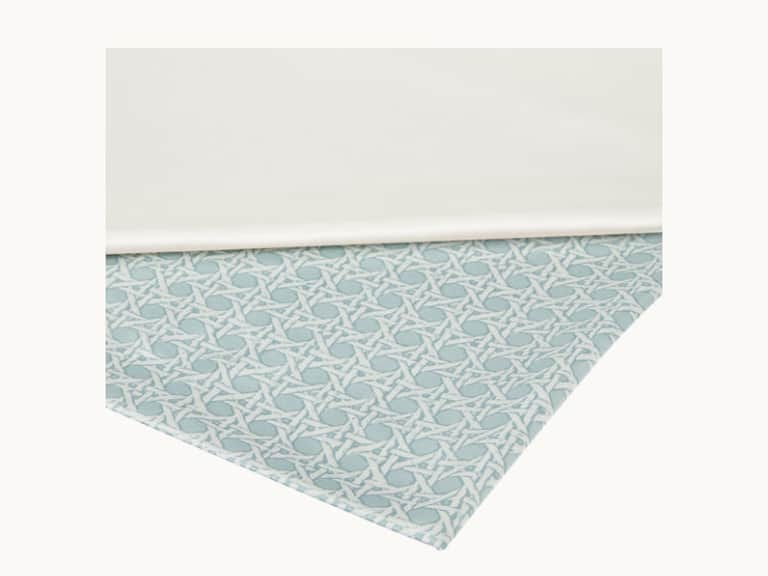
Color and pattern introduce another layer of choice. The ivory-and-patterned border of the Rattan Blue Silk Oxford Pillowcase gives the edge a role in the composition of the bed. A plain ivory or mocha case is quieter, and may be easier to mix with existing sheets. The choice is not merely between neutral and decorative. It is between different ways for a small rectangle of fabric to participate in a room.
Closures and the ordinary life of a pillow
An envelope closure folds one end of the case over the pillow, keeping the insert inside without buttons or a zipper. It avoids hard hardware near the face and produces a clean finish, though the overlap should be ample enough to contain the pillow during ordinary use. In the morning, the case may need a quick adjustment; this is not a flaw so much as a familiar consequence of making a soft object from soft cloth.
Other closures can be useful in different settings, but comfort at the head of the bed is only one consideration. A zipper may help hold an insert in place, yet a poorly positioned or rigid zip can create an uncomfortable edge. Buttons add a visible detail and another point of wear. With an envelope closure, the design remains relatively simple: the fabric itself does the work.
It is worth checking dimensions before choosing any pillowcase. A case designed for one pillow size may not fit another neatly, even if the labels sound similar. Too little ease can strain seams and flatten the fabric; too much can leave excess material gathered around the pillow. The Oxford border also needs to be considered in relation to the pillow’s actual size, since the border changes the overall outline. An attractive finish is more convincing when the case fits the pillow it is meant to cover.
These considerations connect a pillowcase to the rest of the sleep setup. A silk cover may sit alongside cotton or sateen sheets, a duvet, and a pillow with an entirely different filling. There is no requirement that every layer match in fiber. A smooth silk pillowcase can be paired with a fitted sheet in another fabric, just as a decorative Oxford case can be layered over a practical Housewife case. The bedroom is not a laboratory in which every variable must be held constant; it is a place where materials meet according to habit and preference.
Care is part of the design
Silk asks for gentler handling than many everyday cotton fabrics. The care instructions supplied for Gingerlily pillowcases generally call for a delicate machine-wash cycle at no more than 30°C, a mild liquid detergent, and air drying. Some descriptions also recommend turning pillowcases inside out before washing and using a cool iron if needed. The instructions on the specific item should take precedence, since finishes and constructions can vary.
Gentle washing is less mysterious than it sounds. Avoid aggressive cycles, high heat, and detergents that may be too harsh for delicate fibers. Do not overload the machine: a crowded drum can encourage unnecessary abrasion and creasing. After washing, reshape the case and allow it to dry naturally, away from excessive heat. If ironing is appropriate, use a cool setting and follow the item’s care guidance. A little patience can preserve the surface and help the seams keep their shape.
Regular laundering is still important. A pillowcase is in close contact with skin and hair for hours at a time, so it belongs in a normal bedding-washing routine. The precise frequency will depend on personal needs, climate, and household habits. Silk does not eliminate the need to wash bedding, and “naturally hypoallergenic” should not be read as a promise that a textile cannot collect dust, oils, or other residues. Cleanliness comes from care, not from a fiber’s reputation.
Storage matters, too. A case put away while damp may develop an unpleasant smell, and prolonged exposure to strong sunlight can affect textiles. Fold it loosely in a clean, dry place rather than leaving it pressed beneath heavy objects. These are unremarkable instructions, but unremarkable care is what allows a fabric intended for nightly use to remain part of ordinary life.
A pillowcase cannot choose your pillow
When selecting a pillow, begin with the job it must do. Sleep position, shoulder width, mattress firmness, and personal preference all influence the loft and support that feel comfortable. A side sleeper may want a different height from someone who sleeps on the back; a person who shifts positions through the night may value a pillow that adapts easily. These are questions about the fill and shape, not about the pillowcase.
Gingerlily’s product range includes a Mulberry Silk Blend Pillow, which is distinct from its silk pillowcases. The pillow is described as having layers of long-strand mulberry silk floss with a supportive polyester core, encased in cotton sateen. That construction concerns the pillow’s fill and casing. It should not be confused with a 100% mulberry silk pillowcase, whose role is to cover a pillow and create a smooth outer surface.
In other words, buying a silk pillowcase does not mean buying a silk-filled pillow. If your existing pillow provides the support you like, changing its cover may be enough to alter the surface feel. If the pillow itself has become lumpy, too high, or uncomfortable, a new case will not solve that problem. Separating the two decisions helps make the choice more precise—and prevents the phrase “silk pillow” from carrying more meaning than it can reasonably bear.
Claims about hair and skin deserve similar care. A smooth textile may reduce friction compared with some rougher fabrics, and some sleepers find that pleasant. But a pillowcase is not a medical treatment, and results will vary with hair type, skincare, sleep habits, and many other factors. It is reasonable to choose silk for its feel, appearance, or place in a bedding palette. It is less reasonable to expect one piece of fabric to do the work of a clinician, a sleep routine, or a well-fitted pillow.
The quiet importance of the surface
Much of the bedroom is experienced indirectly. We notice the light, the temperature, perhaps the weight of a duvet. A pillowcase is closer: it meets the face, catches the hair, and moves whenever the sleeper turns. Its influence is small but repeated. A smooth surface may make the bed feel more considered; an Oxford border may give the arrangement a little architecture; a Housewife case may disappear into the practical rhythm of changing the sheets.
That is the appeal of paying attention to the cover without confusing it with the object inside. A pillowcase does not need grand claims to justify its presence. It can offer a particular hand, a particular edge, a color that steadies the room. Gingerlily’s silk designs make those decisions legible through their fabric, weight, closures, and finishes. The questions are ordinary ones: Do you like a border? Will the case fit your pillow? Are you willing to follow a delicate wash routine? Does the surface feel pleasant when the room is cool, or when it is warm?
The most useful answer may be the simplest: choose a pillow for support and a pillowcase for contact. Consider fill and loft separately from silk and seams. Treat product language as a guide to construction, not a substitute for experience. Then let the bed be what it is—a set of layers, not all alike, arranged to make the long, unobserved hours of night a little more comfortable.
A quick guide to the distinction
- Pillow fill and loft: determine much of the pillow’s shape, support, and feel beneath the head.
- Pillowcase fabric: creates the outer surface that touches skin and hair.
- Oxford style: adds a border around the central panel for a framed appearance.
- Housewife style: uses a simpler outline without the Oxford border.
- Envelope closure: folds fabric over the pillow to contain it without buttons or a zipper.
- Momme: describes silk fabric weight; it is one useful specification, not a complete verdict on quality or comfort.
- Care: follow the instructions for the specific case; delicate washing, mild detergent, and air drying are common recommendations.
Comfort is personal. Material descriptions can explain how a product is made, but they cannot predict exactly how it will feel to every sleeper.